The Chronicle today: two composite manuscripts
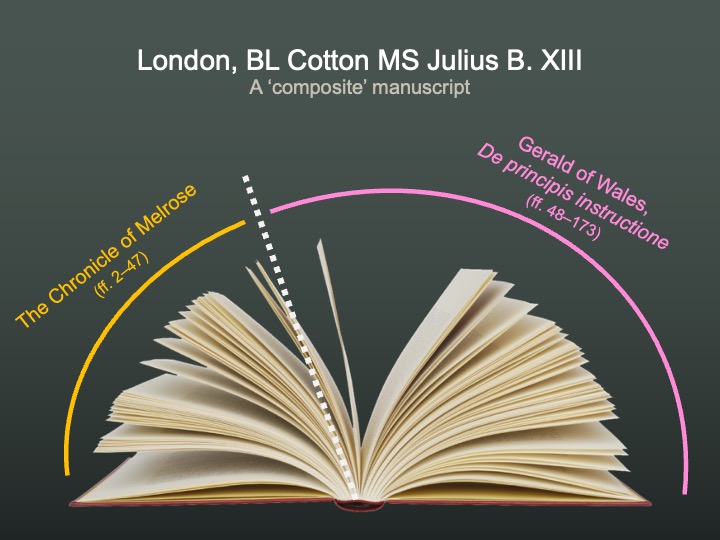
The Chronicle of Melrose is currently divided into two sections, each part of a ‘composite’ manuscript in the British Library’s Cotton collection. A composite manuscript is one where different items have been brought together into one binding. Typically, these items were once independent volumes with no known association. An owner might create a composite volume in order to bring together texts on a similar topic.
Cotton MS Julius B XIII: see here for The British Library online catalogue entry
- ff. 2–47: The Chronicle of Melrose Abbey (Hugh of St Victor’s Chronicle followed by annals for AD 1–249).
- ff. 48–173: Gerald of Wales, De principis instructione (manuscript datable to the 2nd quarter of the 14th century).
Cotton MS Faustina B IX: see here for The British Library online catalogue entry
- ff. 2–75: The Chronicle of Melrose Abbey (introduction from AD 731 followed by annals for AD 734–1270, with a smattering of annals in the 1270s and 1280s, plus incorporated texts).
- ff. 76–244: The Tynemouth Chronicle based on Nicholas Trevet’s Annales and the writings of William Rishanger, AD 1259–1306 (manuscript datable to between the 4th quarter of the 14th century to the 1st quarter of the 15th century).

It is likely that John Leland (d. 1552) was responsible for dividing the Chronicle of Melrose into two (according to Harrison, The Chronicle of Melrose Abbey, p. 181). Leland began collecting manuscripts probably after 1536, and had fallen into ‘madness’ by 1547. If he acquired the Chronicle from Thorney Abbey, as has been suggested, then this would have been before the abbey’s dissolution in December 1539 (Harrison, The Chronicle of Melrose Abbey, p. 176). Leland seems to have regarded the second part from AD 731 (now Faustina B IX, ff. 2–75) as an abridgement of Roger of Howden’s work (see the remains of a title Epitome <Rogeri Houeden> on Faustina B IX, f. 2r). It is notable that Leland (very likely Scribal profile 16) added many signposts to the margins of Faustina B IX, but very few to Julius B XIII. Julian Harrison also observes that since Leland had both De principis instructione and the Tynemouth Chronicle in his possession, it was likely him that joined the Chronicle of Melrose to these other works.
Because of this division, for a long time it was not realised that the two manuscripts were once part of the same entity from Melrose Abbey. This was only made explicit in print in 2007 (Broun, The Chronicle of Melrose Abbey, esp. chapter 4).
Author: Jo Tucker
Last updated: 07/07/2026