What was the original Chronicle?
What did the Chronicle of Melrose look like to its very first scribes and readers? What constitutes the ‘original chronicle’, before it then ‘grew’ in stages?
Broun and Harrison (The Chronicle of Melrose Abbey, pp. 48–9, chapter 5) regarded the ‘original’ chronicle as comprising:
- Julius B XIII, ff. 2–47
- ‘Scribe 1’ [Scribal profile 3]: Prologue to Hugh of St Victor’s Chronicle
- ‘Scribe 3’ [Scribal profile 8]: Hugh of St Victor’s Chronicle
- ‘Scribe 5’ [Scribal profile 24]: annals for AD 1–249
- Faustina B IX, ff. 2–22 (excluding f.14, which was inserted later)
- ‘Scribe 5’ [Scribal profile 24]: an introduction quoting Bede’s Ecclesiastical History from AD 731 followed by annals for AD 734–956 (ending mid-sentence)
- ‘Scribe 6’ [Scribal profile 37]: annals for AD 956 (continued mid-sentence)–1016
- ‘Scribe 3’ [Scribal profile 8]: annals for AD 1017–1171 (ending at f. 21r)
In terms of gatherings, this would have comprised:
- Julius B XIII Gathering I: 8 folios
- Julius B XIII Gathering II: probably originally 10 folios (one later cut away)
- Julius B XIII Gathering III: probably originally 10 folios (one later cut away)
- Julius B XIII Gathering IV: 8 folios
- Julius B XIII Gathering V: probably originally 6 folios (final one later cut away)
- Julius B XIII Gathering VI: probably originally 8 folios (final one later cut away)
- Potentially one or more gatherings lost containing annals after AD 249 (read more on that here)
- Faustina B IX Gathering I: 10 folios
- Faustina B IX Gathering II: 10 folios (f. 14 was inserted later)
To summarise Broun, The Chronicle of Melrose Abbey, chapter 4 (‘Recovering the Chronicle of Melrose’, pp. 48–55), the manuscript originated as a single ‘project’ with these principle scribes working simultaneously on the different sections (Broun’s Scribes 1, 3, 5 and 6). The scribes of the annals had, according to Broun, an ‘authorial’ role, being individually responsible for selecting their sources to shape the resulting text. Broun is clear that the scribes must have been working at Melrose Abbey (p. 45, n. 34): ‘Any reservation about Melrose as the home of these scribes (on the basis that Melrose may have acquired this manuscript rather than created it) can be dispelled by the highlighted presentation (in red ink) of the entries on the foundations of Cîteaux (1098), Rievaulx (1132, Melrose’s mother-house), Melrose (1136, in slightly larger writing), Kinloss (1150) and Holm Cultram (1150, both daughter-houses of Melrose).’ This must apply also to Hugh of St Victor’s Chronicle being copied at Melrose, given that scribal profile is also found in the annals.
When was this ‘original chronicle’ created? Broun’s dating was based on two features in the work of ‘Scribe 3’: (i) the extension of a time-frame at the end of Hugh of St Victor’s Chronicle to 1174 (which likely suggests that the scribe was working in or before this year, otherwise the scribe would surely have continued the frame onto the next page up to his own time: see Scribal profile 8 on Julius B XIII, f. 40r); and (ii) a reference under the annal AD 1170 to David, brother of the king, as ‘earl’ (which according to Broun could have been feasible any time after David was granted Huntingdon, albeit speculatively, in 1173: see Faustina B IX, f. 20v). Broun therefore dated the creation of the chronicle to ‘1173×4’. (This second point is discussed further under Dating the earliest Chronicle scribes: Scribal profile 8’s reference to David as ‘earl’.)
The Andersons (The Chronicle of Melrose, p. xiv) arrived at ‘1185×98 (1185×6?)’ as the date of the original chronicle, again based on their interpretation of when David could feasibly be described as ‘earl’, which they took to be most likely after he was in full possession of the earldom of Huntingdon in 1185. Their latest date related to either the birth of William’s son Alexander II in 1198 or William’s marriage to Ermengarde de Beaumont in 1186.
A. A. M. Duncan (‘Sources and uses in the Chronicle of Melrose’, p. 149) points out that the final passage of this original chronicle (i.e., the description of Becket’s death in the annal for AD 1171, attributable to ‘Scribe 3’/Scribal profile 8) reads as though it was written ‘before the penances of the guilty were known in 1171–72’, which in reality would be before the spring of 1172. This section of the chronicle does indeed read like that (Faustina B IX, f. 21r): ‘May the sword of the Lord, the highest deliverer, take vengeance immediately against the flesh of the evil-doers, especially those who perpetrated the abominable deed, gave the order, furnished advice, and showed agreement; in sum, initiators, followers, and all assistants who had notice beforehand of this evil of evils.’ This date limit, however, would only apply to the composition of that portion of text or its exemplar, not necessarily the copying of it into the Chronicle.
Various interpretations are therefore possible for dating the early Chronicle. The digital edition – and in particular the new analysis and dating of scribal profiles which attempts to strip away as many assumptions as possible – affords the opportunity to look at this question again. Instead of searching for the ‘initial’ or ‘original’ chronicle, we might reframe this as an even more neutral question: what are the earliest portions of the manuscript?
To identify the earliest gatherings requires a combined assessment of each one’s contents and scribal profiles. We must also imagine the gatherings to be unbound, rather than in their current set order (see the manuscript‘s Binding history). In this case, there are four distinct ‘units’ which could potentially be the oldest. They are ‘units’ because each could, in theory, have been physically and textually independent at their moment of creation:
- Unit 1. Julius B XIII, Gatherings I–V: Hugh of St Victor’s Prologue (Scribal profile 3) and Chronicle (Scribal profile 8). These two sequential stints are taken together as one ‘unit’, though strictly speaking the Prologue may have been copied as a separate activity before the following pages were then ruled and the Chronicle was added. However, it seems more logical that they were part of the same campaign. In total this unit occupies five gatherings, with one page left blank at the end. In terms of dating this unit, Hugh of St Victor’s Chronicle was thought to be composed some time between 1124 and 1137 (Hugh died in 1141). As in other early versions, Scribal profile 8 takes the list of popes and rulers down to the pontificate of Honorius II (1124–30) and no further. The scribe did extend the chronological ‘frame’ to 1174 at the foot of the page, but this could just as likely be them filling the space on the already-ruled folio rather than necessarily working in or after 1174 (see Julius B XIII, f. 40r). Palaeographically, both scribal profiles are datable to probably the second half of the 12th century.
- Unit 2. Julius B XIII, Gathering VI: Annals for AD 1–249 (Scribal profile 24), occupying a single gathering and finishing mid-sentence. The main source for these annals is Bede’s Chronica Maiora, which runs from the Creation to the 720s. Palaeographically, the scribal profile is datable to probably the second half of the 12th century.
- Unit 3. Faustina B IX, Gathering I: An introduction from AD 731 and annals for AD 734–956 (Scribal profile 24), occupying six and a half folios in a ten-folio gathering, finishing mid-sentence at the bottom of f. 8r. The reference to Henry II as earl of Northumberland under AD 950 (Faustina B IX, f. 8r) means that this stint must have been written after 1157 when the earldom was confiscated from William the Lion by Henry II (as identified by the Andersons, The Chronicle of Melrose, p. xxvii). Palaeographically, the scribal profile is datable to probably the second half of the 12th century.
- Unit 4. Faustina B IX, Gathering II (minus f. 14): Annals for AD 1017–1171 (Scribal profile 8), occupying a single gathering with one blank folio at the end. The reference to David, brother of the king, as ‘earl’ under AD 1170 (Faustina B IX, f. 20v) means that this stint must have been written after 8 March 1173 at the very earliest, but possibly quite a few years or even decades later (see Dating the earliest Chronicle scribes: Scribal profile 8’s reference to David as ‘earl’). Palaeographically, the scribal profile is datable to probably the second half of the 12th century.
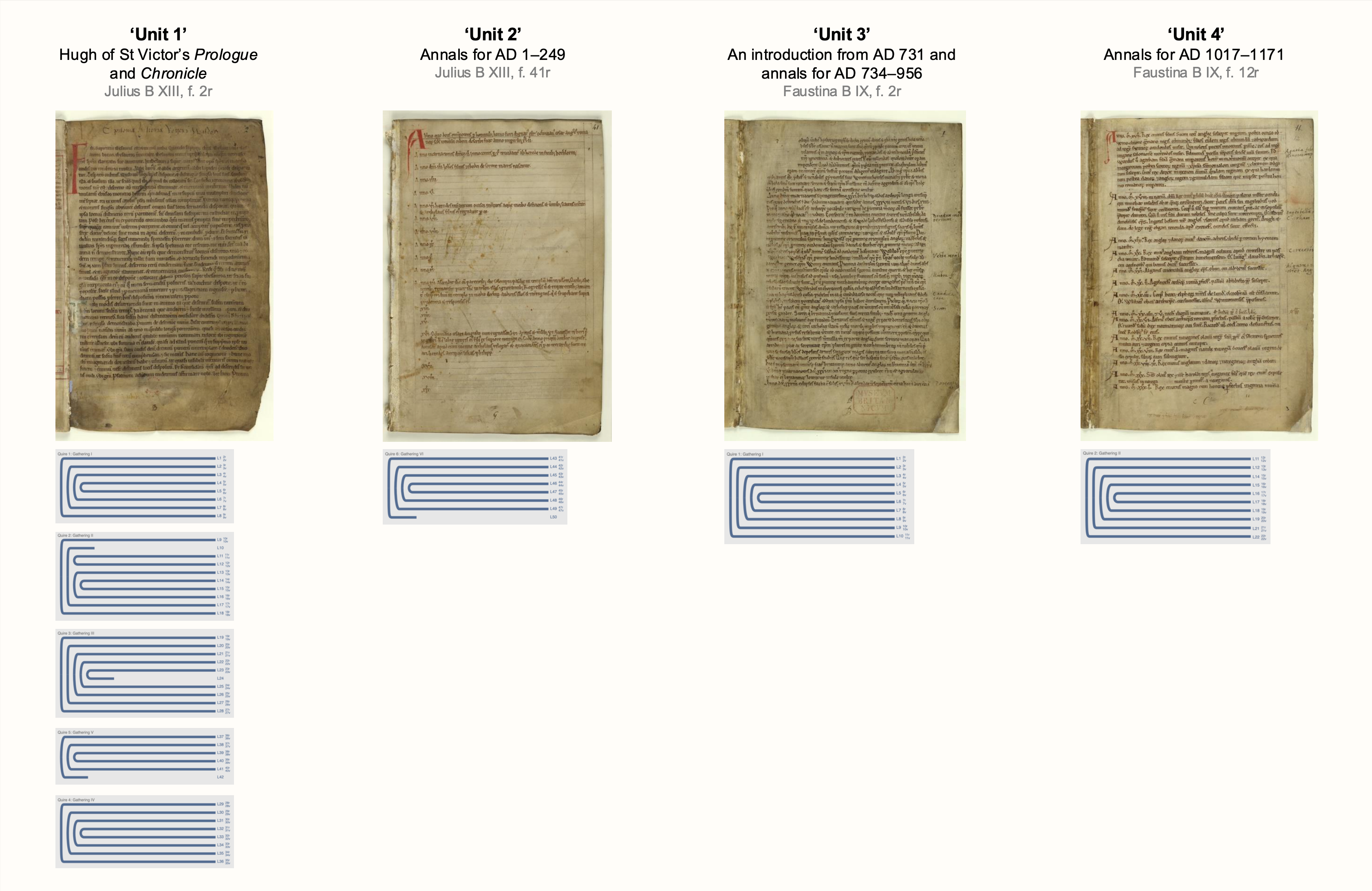
Each unit gives an impression of being an ‘opening’ section, beginning the fresh text with a large rubricated initial (though the P is missing from unit 3): see the opening pages of unit 1 (the Prologue), unit 2 (AD 1), unit 3 (summary from AD 731), and unit 4 (AD 1017). Unit 3‘s text begins especially like a new work: ‘After the venerable Bede ... stopped writing, other sure and seamless narrators have not been found... . Accordingly, we undertake, therefore, to run through the course and condition of the times very briefly from that period...’ (Faustina B IX, f. 2r). Were these units created simultaneously, or in a sequence, or entirely independently?
Unit 1 (Hugh of St Victor’s Chronicle) and unit 2 (annals from AD 1–249) could, indeed, be physically and textually independent items. Units 3 and 4, however, are sequential in their run of annals. Given that unit 4 begins at AD 1017, it is tempting to assume that unit 3 was in existence and already contained the continuation from AD 956–1016 (Scribal profile 37) when unit 4 was begun. This continuation filled from f. 8v to the end of the gathering at f. 11v, though there was a gap of half a page left which suggests unit 4 (from AD 1017) could, in practice, have already been started independently. It is certainly possible for a chronicle text to begin in a chosen year (the ‘Chronicle of the Kings of Mann and the Isles’, for example, begins at AD 1000, though it is selective in the annals it covers: London, BL Cotton MS Julius A VII). Unit 4’s opening Anno (with a rubricated initial A and two majuscule Ns) gives the impression it was not simply a continuation, though there is no opening introductory text (as in unit 3) or title (as in the Chronicle of the Kings of Mann and the Isles). There is no firm evidence, therefore, about the order of the creation of these units or whether they were part of one project of work.
An alternative perspective on this question is the preparation of the folios: looking at the general size, layout, ruling and feel of the folios across all four units, there is some uniformity, at least across all of the annals (for ruling, see Harrison, The Chronicle of Melrose Abbey, p. 62). This may be an illusion encouraged by the later cropping and binding of the folios, of course, and so it does not prove that the texts were all necessarily written in a single campaign, but it does leave it as a viable possibility.
Palaeographically, all of the profiles involved in these units are datable to the second half of the 12th century. According to Broun’s analysis (pp. 223–7), a few features suggest this: there is no evidence of ‘biting’ in these profiles (i.e., compressing letters together); the Tironian et symbol is always uncrossed; the shaft of t does not protrude above the horizontal stroke; and s at the end of a word is typically ‘straight’ rather than ‘round’. On the basis of the inclusion of the tailed ę, it might seem that Scribal profile 24 is datable to the 1150s, 1160s or early 1170s, but that is not necessarily the case (see the information on palaeographical dating under Scribal profiles).

There is no firm terminus ante quem for any of these units (i.e., a latest date of creation). The best indicator would be when the text began to receive additions. Unfortunately, most of these continuations are also only datable with a termini post quem (i.e., an earliest date, not an exact date of writing). For example, for unit 4, the ‘continuation’ of the annals is attributed to Scribal profile 60 which was responsible for AD 1171–97 and is datable after 17 March 1199 (given a reference under AD 1193 to the memory of Jocelin, bishop of Glasgow). Palaeographically, the profile seems to be early 13th century. But this does not provide a hard date for when Scribal profile 8’s stint was completed. The only relevant indication of a terminus ante quem in the Chronicle is in the work of Scribal profile 18, which contributed to Hugh of St Victor’s Chronicle probably before 1216 (when Honorius III could have easily been added to the list of popes at the end, on Julius B XIII, f. 40v), and possibly before 1208 (which is as far as the scribe goes with numbering Innocent III’s chronological frame on f. 40v). This would mean that, at the very least, unit 1 was certainly in existence by 1216 and possibly by 1208. The palaeography, however, suggests it was in existence earlier than these latest limits. Evidently, therefore, the gap between ‘creation’ and ‘continuation’ may have been a few years, or a few decades.

Were these four ‘units’ all created at Melrose? Scribal profile 8 is the only one that can confidently be associated with the abbey, given the nature of the events highlighted in red ink in its section (discussed by Broun, The Chronicle of Melrose Abbey, at p. 45, n. 34). This would mean units 1 and 4 were certainly produced at Melrose. It remains a possibility that units 2 and 3 (respectively, annals for AD 1–249 and those from AD 731 to 956) were produced elsewhere, arriving at Melrose in the late 12th century where they were supplemented with more gatherings and received interlinear and marginal additions. The consistent folio ruling and size might argue against this, although it is possible that this style was simply copied at Melrose for the sake of consistency.
It is therefore not possible to say definitively which unit was created first or whether they were all undertaken roughly simultaneously. It is also not clear whether the earliest scribes conceptualised all four units as one ‘project’ or ‘work’, or whether they were regarded as separate. Given that there are two scribal profiles which appear in two units (Scribal profiles 8 and 24), the image of a single campaign of work is persuasive, though not conclusive. One plausible scenario is that unit 3 was created first. The task was to continue Bede’s Ecclesiastical History of the English People, which the scribe extended to AD 956 and then supplemented with earlier annals (from AD 1). Another scribe continued from AD 956 to 1016, and then another extended this again to AD 1171. This last scribe had also been tasked with copying Hugh of St Victor’s Chronicle, which was then appended to the annals. This would explain why unit 3 seems to begin with an introduction.
Ultimately, the creation of the Chronicle of Melrose remains somewhat elusive, though is datable broadly to the fourth quarter of the 12th century (after 8 March 1173: for this date, see Dating the earliest scribes). What we can say is that by the early 13th century, a scribe at Melrose certainly regarded all four units as part of one work (see further here a discussion of the reference in the margin of Hugh of St Victor’s Chronicle to there being lost annals between AD 249 and 731).
Author: Jo Tucker
Last updated: 30/07/2026